
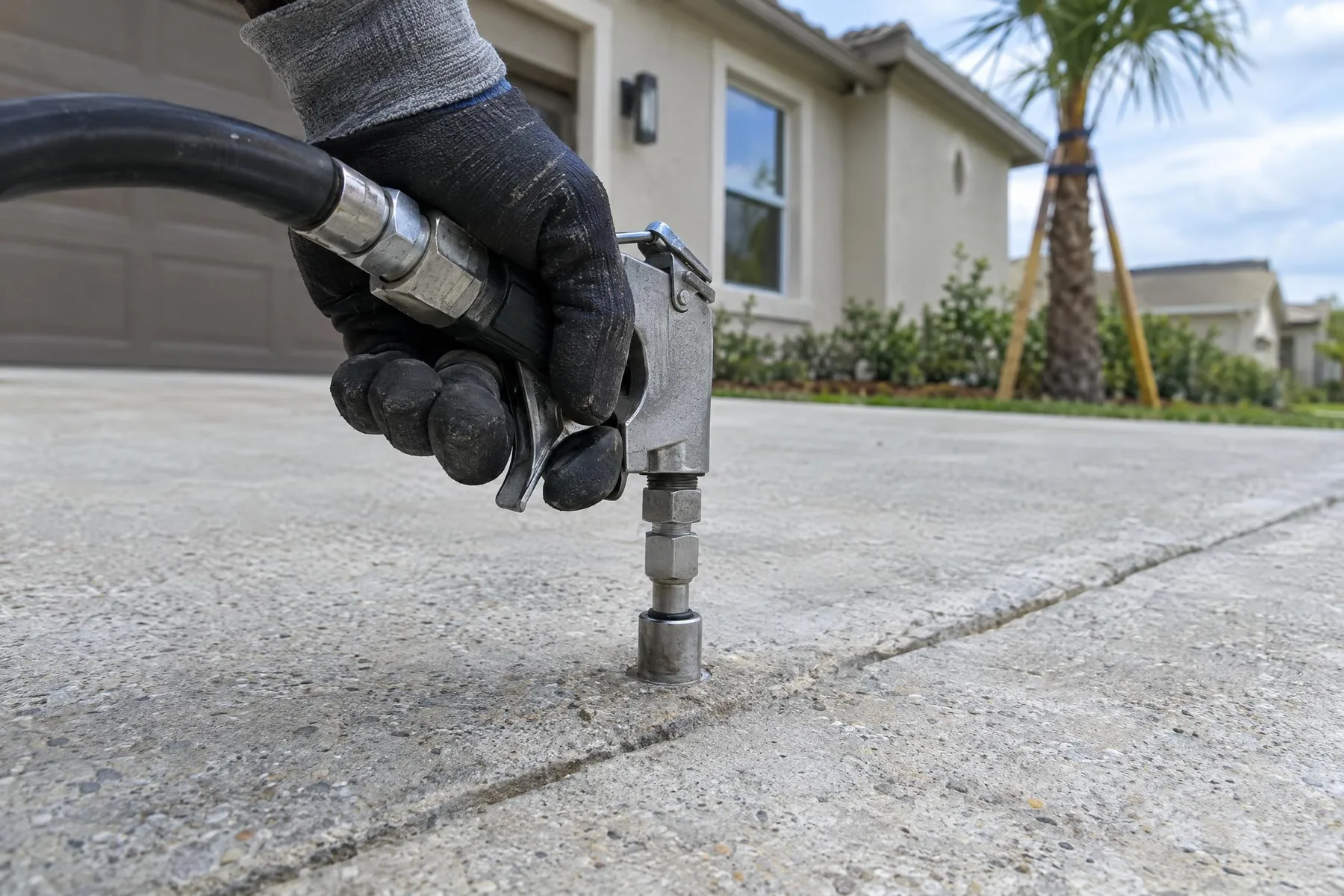
A gloved hand holding an injection gun on a port in a driveway slab, with a stucco house and a young staked palm behind

Polyjacking vs Mudjacking in Miramar, FL: Foam vs Mudjacking and Mudjacking vs Polyurethane Foam

Polyjacking vs Mudjacking in Miramar, FL: Which Lift Fits Your Slab

Choosing between foam and slurry is the first decision on a sunken slab, and Miramar Concrete Leveling & Lifting lays out the tradeoffs for Miramar, FL and Broward County. Here, polyjacking vs mudjacking is weighed for driveways, pool decks, walks and patios, with foam vs mudjacking compared on price and mudjacking vs polyurethane foam compared on staying power. Both methods lift by filling the space beneath the concrete, yet they differ in material, drying time, cost and how they behave in wet sand.

Why homeowners choose us:

  • Free written estimates for every leveling job
  • Small injection holes patched and cleaned up after every lift
  • Water-resistant foam that does not wash out
  • Warrantied work every lift backed by a written warranty
  • Licensed and insured certificate on request

The crew has 18+ years in South Florida and 1,000+ slabs lifted. The estimate assigns each slab a method, which lets you compare the options on your own concrete. A free written quote and a warranty in writing come with every lift. Most jobs run 2 to 6 hours on site, depending on slab size and the depth of the void.

Get a FREE Concrete Leveling Quote

Polyjacking vs Mudjacking: How Each Lifts a Miramar Slab

Polyjacking pumps liquid polyurethane foam through coin-sized holes at pressure. The foam expands, firms the soil and raises the slab, and gauges show when the base is solid. Mudjacking also drills holes but pumps a cement-based slurry instead. Choosing slab jacking vs foam means choosing what gets pushed beneath the concrete.

Slurry lifts through weight and volume, whereas foam rises on expansion alone. One small shot grows many times over and wedges into narrow gaps. Because foam is light, it adds almost no load to soft ground. That difference in weight is why foam can be the safer fill over a soft base. Mudjacking needs wider holes, and the slurry must cure before the slab can carry full loads. Either method demands a watchful crew, because overlifting cracks the concrete, so a level and the gauges guide the work until the surface matches its neighbor.

Either one works on an intact slab, so soil conditions and how long you can wait settle the choice. A careful estimate counts for more than the method.

Appearance and cleanup differ too. Foam holes stay small and vanish beneath a sanded cap, but slurry holes are wider and leave a bigger round mark. A mixing truck and long hoses need space too, and a narrow side yard can swing the decision toward foam. The sections below put numbers on each method and then map them onto your own surface.

Polyjacking vs Mudjacking: Cure Time and Cost in Miramar

Foam sets in 30 to 60 minutes, while mudjacking dries over one to three days, and foam costs a fifth to a half above the price of mudjacking or stone slurry grout. A table puts the two side by side:

FactorPolyurethane foamMudjacking
MaterialExpanding polyurethane foamCement-based slurry
Hole sizeAbout the width of a coinWider than foam holes
Cure time30 to 60 minutesOne to three days to dry
Walk on it15 to 30 minutesAfter the slurry sets
CostAbout 20 to 50 percent moreLower, and stone slurry runs $750 to $1,500
How long it lasts5 to 10 years or more5 to 10 years

The premium buys speed and less mess on the lawn, plus a slab back in service within the hour. Patches from mudjacking show more because the holes are wider. Mudjacking suits jobs where budget outweighs waiting, such as a back walk nobody needs this week. Foam ranges by surface are listed on the cost page, and the written estimate prices that gap on your slab.

Waiting for a slab to dry costs more than the paperwork suggests. A driveway that stays closed for three days sends cars to the curb, and a pool deck out of service disrupts a household for just as long. Foam shrinks that window to the visit itself, so owners on tight schedules usually accept the premium. Owners who need the car back the same day tend to choose foam without much debate.

Polyjacking vs Mudjacking on the Sandy Ground Under Miramar Slabs

Soil maps for Miramar list Margate, Pompano and Matlacha soils, all sandy and sitting on limestone. During the wettest months the water table reaches the surface in Margate fine sand, and limestone lies 32 inches below it. Poorly compacted fill leaves the base under a slab soft from day one. Slurry piles heavy weight onto that base, and it can wash out again whenever groundwater moves through.

Foam is water-resistant and stays where it is placed. In ground that stays wet for months, that trait decides how long a lift lasts. It also firms loose grains while it swells, addressing why the slab sank in the first place. Nearly 70 percent of the year’s rain falls between May 15 and October 15, so a June lift faces the worst of the rain within weeks. Which is better, mudjacking or foam, varies with each slab, yet in wet ground water resistance carries real weight. Ask any contractor to name the method before the drill starts, since the choice sets hole size, drying time and the final price.

Mudjacking still earns a place in Miramar, mostly on broad, even voids with open access for the pump, where the lower bill makes sense. The estimate names the method that fits, and it recommends the cheaper one whenever that will hold. Someone selling soon, or with a back walk that sees little use, can reasonably take slurry and keep the savings. A pool deck or a driveway in daily use gets more from foam. HOA boards often prefer foam on shared walks, because a walk that stays shut for days is a bigger headache than the price difference.

Polyjacking vs Mudjacking for a Miramar Driveway, Pool Deck or Sidewalk

Slab type, void size and timeline decide the method. These are the usual calls on the surfaces we lift most:

  • A driveway leans toward foam when the car must be back in the garage that day, though a wide, even void can take slurry.
  • A pool deck leans toward foam, because large voids and wet ground reward a fill that resists water.
  • A sidewalk accepts either method, and run length plus budget settle it.
  • Any slab over soft, wet ground does better with foam, since it compacts the soil while filling.

On the estimate, every slab carries a named method and its own price, which keeps every choice transparent. Concrete in fragments may call for replacement instead, which the visit decides. Owners can ask for a price on both methods for the same slab and weigh the gap themselves. A quote that offers a single method for every slab deserves a question, because one property can need both.

Polyjacking vs Mudjacking FAQs: Miramar, FL

Which is better, mudjacking or foam?

Foam cures faster, uses smaller holes and repels water, whereas mudjacking costs less. In Miramar's wet sand foam fits most slabs, and mudjacking earns its place on a broad, even void when money is tight.

Is the choice between polyjacking and mudjacking only about price?

Partly, since foam costs 20 to 50 percent more. The extra money pays for a slab you can use within the hour, holes that vanish under a patch and a fill that resists water.

What is the difference between foam and mudjacking?

Mudjacking pumps a cement-based slurry, while foam jacking injects expanding polyurethane under pressure. That one choice drives hole size, drying time and behavior in wet ground.

How long does each method last?

Expect mudjacking to hold up for about 5 to 10 years, with foam matching that span or exceeding it. Soil, rainfall and the weight above all play a part.

Can the two methods be mixed on one property?

Yes, the estimate names a method per slab, so a driveway may get foam while a back walk gets slurry. Each slab keeps its own price line.

Does either method fix cracks?

A crack stays a crack either way, though a lift to level can keep it from worsening. Concrete shattered into small pieces may need replacement.

Does the work come with a warranty?

Every job carries a written warranty. Its terms are printed in the estimate before drilling begins, and the office reads them to you whenever you ask.

Miramar Concrete Leveling & Lifting serves Miramar and Broward County.

Get a Free Concrete Leveling Quote in Miramar, FL

(954) 287-1672 Get a Free Quote