
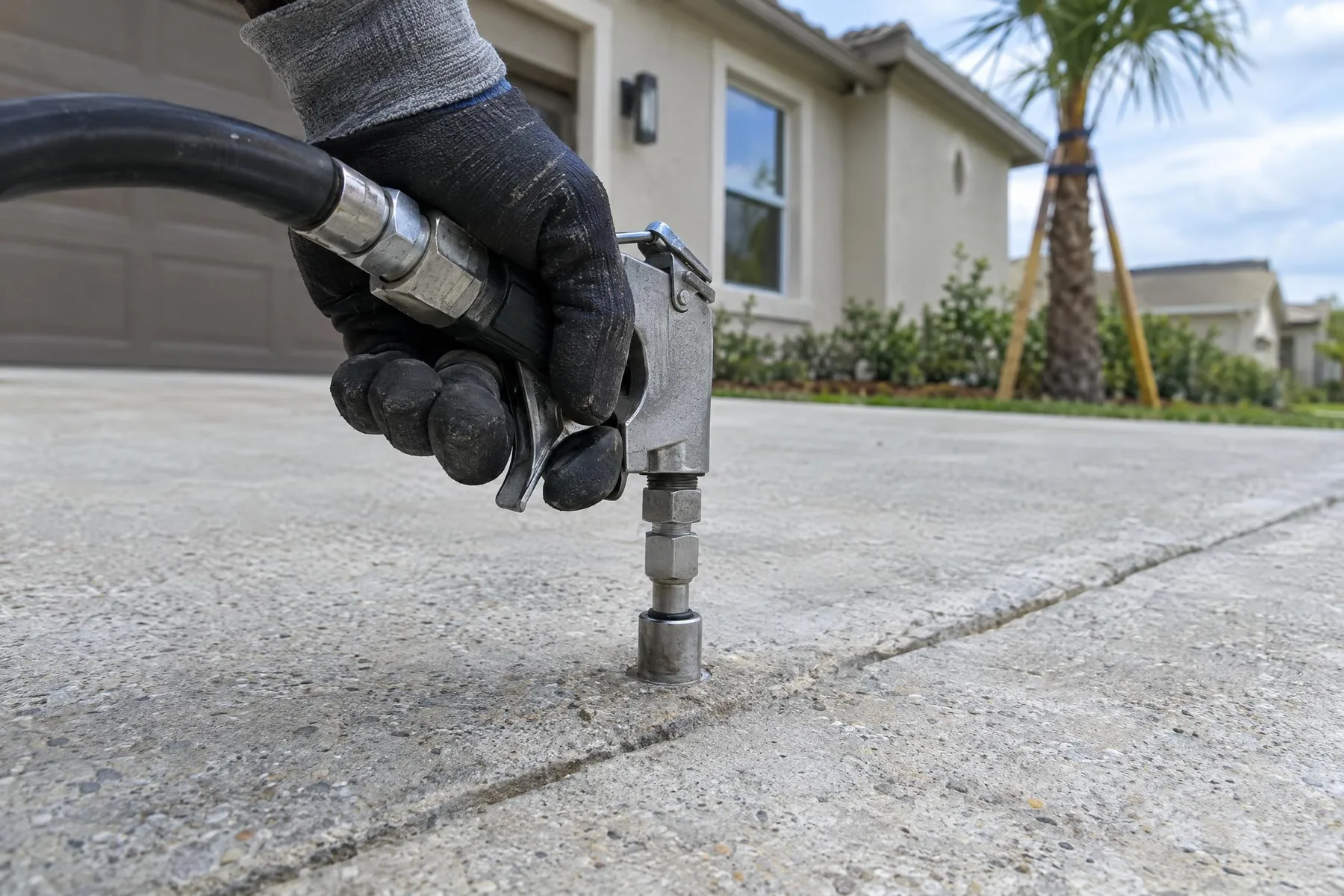
A gloved hand holding an injection gun on a port in a driveway slab, with a stucco house and a young staked palm behind

How Concrete Leveling Works in Miramar FL: How Does Polyjacking Work, How Does Concrete Lifting Work

How Concrete Leveling Works on a Miramar, FL Slab, Step by Step

Raising a sunken slab takes no demolition, and Miramar Concrete Leveling & Lifting shows how it works across Miramar, FL and Broward County. Below is the answer to how does concrete leveling work. It also explains how does polyjacking work on a sunken slab and how does concrete lifting work on driveways, patios, pool decks, walks and garage slabs. The sequence is short: drill, inject, lift and patch. Each stage of the concrete leveling process appears in its own section below.

Why homeowners choose us:

  • Free written estimates for every leveling job
  • Small injection holes patched and cleaned up after every lift
  • Water-resistant foam that does not wash out
  • Warrantied work every lift backed by a written warranty
  • Licensed and insured certificate on request

The crew carries 18+ years of South Florida work and 1,000+ slabs raised into every job, and the steps stay the same each time. The estimate lists them before any drill starts. You get a free written quote and a written warranty for the lift. Most jobs run 2 to 6 hours, depending on slab size and the depth of the void.

Get a FREE Concrete Leveling Quote

How Concrete Leveling Works: Why a Miramar Slab Sinks First

Every slab depends on the ground beneath it. When that ground weakens or shifts, the concrete loses its support, flexes and cracks, then drops, leaving trip edges at the seams and puddles where the slope once drained. A proper lift rebuilds support under the concrete and not only its height, so the work starts with the soil.

Miramar’s ground is sand over limestone. Soil maps list Margate fine sand, Pompano fine sand and Matlacha gravelly fine sand, and in the wettest months the water table reaches the surface in Margate fine sand. Loose fill compacts poorly, and moving water carries grains out from under a slab, so each season it settles a little further into the pocket.

Nearly 70 percent of the year’s rain arrives between May 15 and October 15. Runoff slides under slab edges and carries sand off, so corners and joints sink first. A slab that sat flat in spring can look noticeably low by October, and the gap keeps widening until the void is packed. Crews begin where the slab dropped first, since that spot holds the deepest void, and the hole pattern follows from there. Voids at a driveway corner and along a pool deck edge need different hole layouts.

Setting adds to the picture. A slab poured over thin fill, or next to a canal or pool, sits in ground where water moves most freely, which means it settles earlier than a neighbor on firmer soil. Poor workmanship is not the cause. Soil shifted underneath it, and leveling replaces the support that soil used to provide. An early lift is the cheapest, because the void is still small and the foam volume stays low.

How Concrete Leveling Works in Four Steps on a Miramar Driveway, Patio or Pool Deck

The question of how does concrete lifting work comes down to four stages. These concrete leveling steps never change from one surface to the next, and only the hole count grows with slab size.

1. Drilling the Holes

Technicians bore coin-sized holes through the sunken slab at intervals of about five feet, with extra holes at the deepest part of the void. Each hole takes only minutes, and dust is swept up as the work goes. Anything that cannot move, such as plants or furniture, gets covered. Small holes also let the slab keep its strength.

2. Setting Ports and Injecting

Foam does the lifting here, which is how polyjacking works in practice. Liquid polyurethane enters each port at pressure, expands to fill the void and binds the loose sand. Gauge readings show when the ground is firm, so stability is confirmed before any lift begins. The foam is already hardening as the crew works.

3. Lifting the Slab

If the slab needs to rise, the crew adds foam in small increments and the concrete climbs toward its original height. A level tracks progress the entire time, and the crew stops the moment the surface is flush with the next slab. Technicians watch seams and walls for movement as the slab climbs. Pushing too far could crack the concrete, so this stage rewards patience.

4. Filling the Holes and Cleaning Up

Each hole gets a sanded-concrete cap, and the work area is cleaned. Foam sets within the hour, so foot traffic is allowed after 15 to 30 minutes. Most slabs finish in 2 to 6 hours, though a long pool deck can use the whole day.

How Concrete Leveling Works With Mudjacking Instead of Foam in Miramar

Mudjacking relies on identical logic but uses a different fill. Crews drill holes and pump a cement-based slurry under the slab until it rises. Slurry is the heavier fill, it needs wider holes than foam, and the mix must sit one to three days before it has dried completely. Both fills are used in Florida, and the choice follows the slab, the soil and the budget.

Foam is lighter, sets within the hour and resists water, a good match for ground that stays wet for months. In contrast, slurry leans on the soil to bear its extra weight, and soft sand may let the slab sink a second time. Stone slurry grout is the third option, a limestone mix for large and evenly shaped voids. Each slab’s method appears next to its price on the estimate, so the options compare directly. Foam holes shrink to nearly nothing under a patch. Slurry holes are wider and can show as round marks when you look closely, a detail that matters most at a front entry or beside a pool. Both methods end with patched holes and a clean work area. For a full side-by-side, see polyjacking vs mudjacking, and for prices, the cost page.

How Concrete Leveling Works on Miramar Slabs: What It Fixes and What It Does Not

Lifting a slab and packing the void beneath it solves most of what homeowners notice, and the restored slope sends water away so puddles stop forming. Three surfaces make up most of the work:

  • A driveway with a step down at the garage apron
  • A pool deck that has pulled away from the coping
  • A sidewalk where one panel sits above the next

A crack stays after leveling, though a slab returned to grade often keeps it from spreading. A slab fractured into small pieces cannot be raised as a single block. Each broken slab is judged on its own merits during the visit, and the estimate states when replacement is the wiser path. Leveling also leaves the yard’s grade untouched, will not push a slab sideways and cannot fix sinking that comes from a leaking pipe. The visit measures how far the slab dropped, since a very large drop is lifted in stages. The estimator checks for leaks first, since a lift over a leaking pipe only repeats the damage.

How Concrete Leveling Works FAQs: Miramar, FL

How does polyjacking work?

Polyjacking sends liquid polyurethane foam through coin-sized holes beneath a slab. Expanding foam fills the void and firms the soil, then a measured second pass raises the concrete before sanded concrete caps the holes.

How does concrete lifting work on a driveway?

On a driveway the work moves through the same stages as on any slab, starting with drilling and ending with patching and cleanup. Flags go about five feet apart, and the crew watches the concrete rise as the foam expands.

How long does the concrete leveling process take?

Most slabs take 2 to 6 hours, while large or complicated jobs can need a day or more. Slab size and void depth decide the duration.

How soon can I use the slab after it is lifted?

A walk across it is fine after 15 to 30 minutes, cars can follow after 1 to 2 hours, and anything heavy waits about 48 hours.

Will the injection holes show afterward?

Each hole is about the width of a coin, and a sanded-concrete cap leaves it flush with the surface. Nothing about the slab looks unfinished at handover.

Can all sunken concrete be lifted?

Not every slab qualifies, since concrete broken into small pieces may need replacement. The estimator decides on site, and the estimate states the verdict plainly.

Does the work come with a warranty?

Every job carries a written warranty. Its terms are printed in the estimate before drilling begins, and the office reads them to you whenever you ask.

Miramar Concrete Leveling & Lifting serves Miramar and Broward County.

Get a Free Concrete Leveling Quote in Miramar, FL

(954) 287-1672 Get a Free Quote